
What Does an Office Fit-Out Cost in Ireland? A 2026 Guide
"How much does an office fit-out cost?" is the first question nearly every client asks us — and the honest answer is that it depends on the size of your space, the condition of the building and the specification you choose. But you deserve a real starting figure, so here it is up front: as a broad guide, a Category B office fit-out in Dublin in 2026 typically ranges from around €45 to €160 per square foot depending on specification, with furniture usually adding €15 to €40 per square foot on top. Below, we break down what sits behind those numbers so you can budget with confidence.
First, what "fit-out" actually means
Commercial fit-outs are usually described in two categories. Category A (Cat A) is the base condition a landlord typically provides: raised floors, suspended ceilings, basic mechanical and electrical services, and finished walls — essentially a blank, functional shell. Category B (Cat B) is where a company like McCreery comes in: turning that shell into your office, with layouts, partitions, meeting rooms, reception, breakout areas, branding, furniture and technology. Most of the figures in this guide relate to Cat B work on a space where the Cat A services are already in reasonable condition. If the building needs its power, heating or ventilation upgraded, costs rise accordingly.
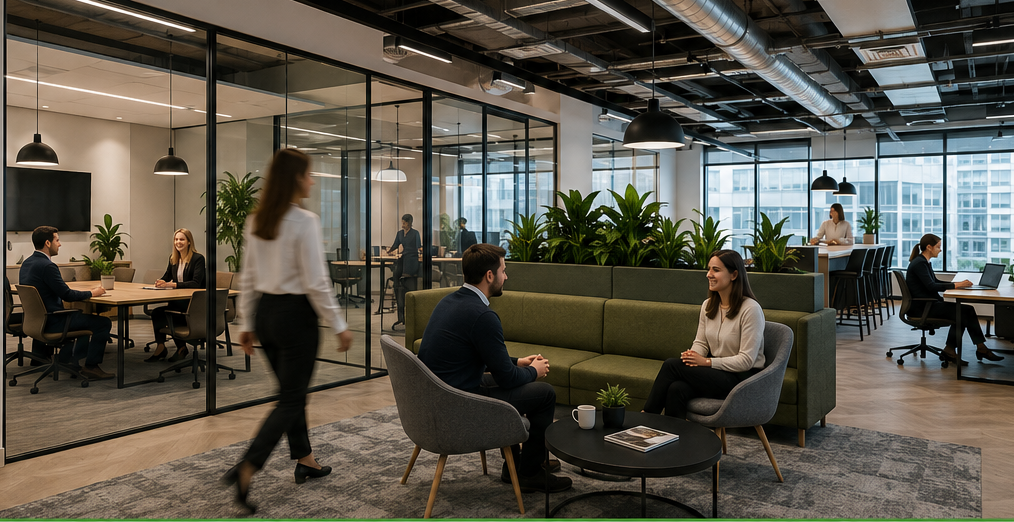
Office fit-out costs Ireland 2026
The three specification levels
Basic / practical (roughly €45–€75 per sq ft). Essential partitioning, fresh decoration, new carpet or vinyl flooring, a simple tea point, reused ceilings and standard, functional furniture. Ideal for a smart but budget-conscious workplace.
Mid-spec (roughly €75–€110 per sq ft). Higher-quality finishes, glazed partitions, properly designed meeting rooms and a boardroom, a genuine breakout or work-café area, better lighting and a mid-range furniture package with some AV.
High-spec / premium (roughly €110–€160+ per sq ft). Bespoke joinery, a feature reception, premium furniture throughout, extensive audio-visual and technology, sustainability features and design-led finishes in every space. When you add full Cat A upgrades, a complete M&E overhaul, professional fees and contingency, an all-in premium project can reach €180–€220+ per square foot.
Where the money actually goes
On a typical fit-out, the two biggest cost categories are construction/builders' work and mechanical and electrical (M&E) services — together they often account for well over half the budget. The rest is spread across partitions and glazing, flooring, joinery, furniture, audio-visual and IT, professional fees (design, project management and any statutory costs, usually around 8–12%) and a sensible contingency of roughly 5–10% for the unexpected. Understanding this split matters, because it shows why the condition of the base building — especially its M&E — has such a big influence on your final figure.
What drives your cost up or down
Size. Larger offices cost more in total but usually less per square foot, because fixed costs are spread across more space. Small suites carry a higher rate.
Building condition and age. A modern building in good order needs less remedial work. Older or listed buildings, or spaces with tired M&E and no usable raised floor, add cost.
Specification and finishes. The single biggest lever you control — the jump from practical to premium finishes can more than double the rate per square foot.
Structural and layout changes. New openings, staircases, extensive glazed partitioning or bespoke joinery all add to the figure.
Location and programme. Dublin city-centre projects, tight timelines and out-of-hours working all carry a premium.
Sustainability targets. Higher energy and environmental standards can raise upfront M&E costs, though they lower running costs over time.
Design and build usually costs less than you'd expect
Fit-outs are delivered either the traditional way — you appoint a designer, then separately tender the build — or on a design and build (D&B) basis, where one company takes responsibility for the whole project. D&B is the more popular route for good reason: a single point of contact, earlier cost certainty, fewer gaps for things to fall through, and a faster overall programme. It's the model we've used at McCreery for decades, and it's usually the most cost-effective way to get a predictable result.
A rough sense of timeline
Every project differs, but as a rule of thumb, design and planning take a few weeks, and a mid-sized fit-out then runs somewhere between eight and sixteen weeks on site. Larger or more complex projects take longer, and early engagement always helps protect both the programme and the budget.
Two worked examples
A 5,000 sq ft Dublin office at mid-spec (around €90 per sq ft) works out at roughly €450,000 for the fit-out, plus about €125,000 for a mid-range furniture package — in the region of €575,000 all in.
A 10,000 sq ft office at a practical specification (around €60 per sq ft) comes in near €600,000 for the fit-out, before furniture. These are illustrations only — your real figure depends on the factors above.
How to keep control of the budget
Start with a proper measured survey rather than a guess. Prioritise spend where it earns its keep — reception, client-facing areas and spaces that support collaboration and recruitment. Reuse what's genuinely worth keeping. Choose a design and build partner so responsibility sits in one place. And always hold a contingency. If cash flow is tight, a good fit-out partner can phase the work so you spread the investment without disrupting the business.
The only way to a real number
Indicative ranges are useful for planning, but the only way to know what your office will actually cost is a site visit and a measured quotation. McCreery has been designing and fitting out workplaces across Dublin and Ireland for over 70 years, for organisations from fast-growing SMEs to names like Diageo, Intel, RTÉ, Kingspan and Pfizer. If you're planning a move, a refurbishment or a refresh, talk to us for a free consultation and a clear, no-obligation quote.
Frequently asked questions
What's the difference between Cat A and Cat B fit-out?
Category A (Cat A) is the basic, functional condition a landlord usually provides: raised floors, suspended ceilings, basic mechanical and electrical services and finished walls — essentially a blank shell ready to be fitted out. Category B (Cat B) is the work that turns that shell into your office: layouts, partitions, meeting rooms, reception, breakout areas, branding, furniture and technology. Most of the fit-out cost a business pays is Cat B, and the figure rises if the Cat A services also need upgrading.
How much does an office fit-out cost in Ireland?
As a broad guide, a Category B office fit-out in Dublin in 2026 typically costs between about €45 and €160 per square foot depending on specification, with furniture usually adding €15 to €40 per square foot on top. A basic, practical fit-out sits at the lower end, while a premium, design-led project with bespoke joinery and high-end finishes reaches the top of the range. The only way to get an accurate figure is a site visit and a measured quotation.
How long does an office fit-out take?
A typical mid-sized office fit-out takes around eight to sixteen weeks on site, following a few weeks of design and planning beforehand. Larger or more complex projects take longer, particularly if they involve significant mechanical and electrical work or structural changes. Engaging a fit-out partner early helps protect both the timeline and the budget.
What is a design and build fit-out?
A design and build (D&B) fit-out is where a single company takes responsibility for both the design and the construction of your office, rather than you appointing a designer and builder separately. It's the most popular approach because it gives you one point of contact, earlier cost certainty, fewer gaps for problems to fall through and a faster overall programme.
What's included in an office fit-out cost?
An office fit-out cost usually covers construction and builders' work, mechanical and electrical services, partitions and glazing, flooring, joinery, furniture, audio-visual and IT, professional fees, and a contingency for the unexpected. Construction and M&E are typically the two largest items. Furniture is sometimes quoted separately, so it's always worth checking whether a price is "all-in" or fit-out only.
How can I reduce my office fit-out cost?
The most effective way to control fit-out cost is to start with a clear brief and a measured survey, then prioritise spend on the areas that matter most — reception, client-facing spaces and areas that support collaboration. Choosing a design and build partner, reusing elements worth keeping, and phasing the work where cash flow is tight all help. Building in a sensible contingency also prevents surprises later.